The Importance of Dining Etiquette: How Basic Manners Can Boost Your Career

Have you ever been in a situation where you were unsure of which fork or spoon to use while dining with your colleagues or clients? Or maybe you were unsure of how to navigate the table setting or which glass to use for which drink? Basic dining etiquette might seem trivial, but it can make all the difference in a business or social setting.

The Importance of Dining Etiquette: How Basic Manners Can Boost Your Career Read More »

Communicate effectively

Improving Accountability at Work

To be accountable means an obligation or willingness to accept responsibility or to account for one’s actions. In an ideal setting, employees are accountable to their colleagues and the organization. But, we live in a world where accountability means differently to each person. How many times have you witnessed the blame game or employees not owning up to their mistakes? Perhaps, quite a few or more if you’ve worked for many years. Often, responsibility is used in place of accountability, but these two are different. The latter refers to what occurs after something has happened. For instance, an employee is responsible for fixing a piece of equipment. After repairs, that same employee is held accountable if the machine’s performance is subpar or fails. Usually, only one person is accountable for what happens after completing a task. This could be any employee, including supervisors, managers and the CEO. If you are a leader, you know you must ensure things get done right. In the end, you’re always answerable for any negative consequence. But accountability has a good side too. Improved performance, better teamwork, increased morale and creativity are benefits when employees become more accountable. So, here’s how you achieve these with the following steps. 1.     Communicate effectively If you’ve been reading our blogs, you’ll always find communication is part of the solution. Your colleagues perform well if you communicate your expectations or desired results. Also, don’t forget to express your belief in their abilities. When you do, you empower your colleagues. Remember that people work better when their leaders trust them enough to do the job. 2.     Set the example You put a plan into action and along the way, things go wrong. Own up and avoid using external factors as excuses. Likewise, when somebody else is being held accountable for your actions, don’t wait for others to clear things up. Just say you’re responsible. 3.     Get feedback Ask for regular updates on the status of ongoing tasks or projects. Sometimes, you might need to catch up on important details or unforeseen developments. This is an opportunity for your colleagues to ask questions or express doubts. They may not be as confident as you are on expected outcomes. Also, they might have concerns with you they’re hesitant to bring up. Lastly, when you’re accountable, you’ll be praised when successful. When this happens, recognize the efforts of those working with you.

Improving Accountability at Work Read More »

Master the Art of Dining Etiquette and Build Strong Business Relationships

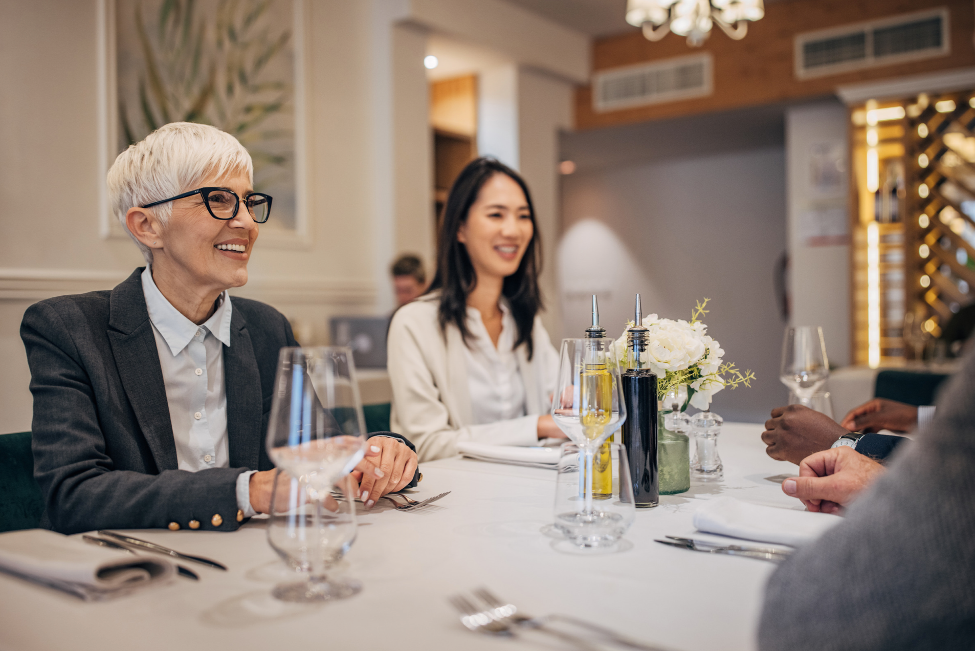
Master the Art of Business Dining Etiquette with These Tips for Lunch Meetings

Time to read: 1-2 minutes.Keywords: Cultural sensitivity, Cultural intelligence, Emotional intelligence, Dining etiquette, Lunch Etiquette workshop.Author: Mylan Holland Summary: Proper dining etiquette is crucial in a business setting and can impact career prospects. Cultural sensitivity and emotional intelligence play an important role in building successful business relationships.Join EQuest Asia’s Lunch Etiquette workshop to learn how to navigate cultural differences and practice emotional intelligence in a work setting. The Importance of Proper Dining Etiquette in a Business Setting Dining etiquette is an essential aspect of any business setting, especially during lunch meetings. It is a way of showing respect to your colleagues, clients, or superiors. In addition to polishing one’s manners, good dining etiquette also plays a significant role in creating a positive impression and fostering good relationships. Proper Dining Etiquette In a work context, lunch meetings are an opportunity to network, build relationships, and close deals. However, improper dining etiquette can ruin the whole experience. According to a study conducted by The Creative Group, “52% of executives believe that poor dining etiquette has a negative impact on one’s career prospects.” Therefore, it is crucial to understand and practice proper dining etiquette, such as using utensils correctly, placing napkins properly, and knowing how to hold glasses and cutlery. Cultural Sensitivity In an intercultural context, dining etiquette varies across different cultures. Understanding and respecting cultural differences is crucial in building successful business relationships. According to Forbes, “Cultural sensitivity and awareness can lead to an increase in productivity, innovation, and creativity, as well as establish better business relationships.” By being aware of and respecting cultural differences, individuals can create a more inclusive and welcoming environment that fosters good relationships. Emotional Intelligence Emotional intelligence is also essential in dining etiquette. Individuals who are emotionally intelligent can adapt to different social situations, communicate effectively, and form strong relationships. According to Harvard Business Review, “Emotionally intelligent leaders are more aware of their team’s needs and can better manage workplace stress, resulting in higher productivity and job satisfaction.” Join EQuest Asia’s Lunch Etiquette Workshop EQuest Asia is hosting a Lunch Etiquette workshop with a particular focus on emotional intelligence. Join us to learn how to navigate different cultural dining etiquette and practice emotional intelligence in a work setting. Sign up now and take the first step towards creating a more inclusive and productive workplace. Master the Art of Dining Etiquette and Build Strong Business Relationships – Sign Up Now for EQuest Asia’s Lunch Etiquette Workshop and Enjoy Early Bird Promotion! 👉 What to read next: The Importance of Dining Etiquette: How Basic Manners Can Boost Your Career

Master the Art of Business Dining Etiquette with These Tips for Lunch Meetings Read More »

The Power of Perception: Why People with High EQ Excel at Reading Nonverbal Communication

The Power of Perception: Why People with High EQ Excel at Reading Nonverbal Communication

Time to read: 1-2 minutes. Keywords: Mindfulness, self-awareness, emotional intelligence, cultural intelligence Summary: Discover how emotional intelligence unlocks the power of perception, enabling people to read and decode nonverbal cues with ease. Author: Mylan Holland In today’s world, communication is more than just words. Nonverbal cues, such as facial expressions, gestures, and eye movements, make up 65% of our communication. Emotional intelligence (EQ) plays a vital role in reading and understanding these cues. Emotionally intelligent people are self-aware and practice empathy, allowing them to quickly perceive nonverbal cues. Paulo Coelho wrote, “The eyes are the mirror of the soul.” The eyes are a powerful indicator of emotions. For instance, genuine smiles cause crow’s feet and result in eye contact. Conversely, shifty eyes may indicate deceit. A blank stare could mean the person doesn’t understand or has lost interest in what you’re saying. Eye-rolling is a reaction to a disagreeable word or action. Glare or pain can cause a squint or narrowing of the eyes. So, don’t immediately assume a person you’re conversing with is expressing anger or contempt. Proximity is another nonverbal cue that emotionally intelligent people pick up on. Personal space varies from person to person, and it’s essential to be sensitive to your audience’s space. According to this article, it’s between 1.5 to 4 feet. It would be wise if you are always sensitive to your audiences’ space. Your message is lost if they’re uncomfortable when you’re too near them. On the other hand, it’s apparent that people are comfortable when they sit or stand close to you. They become more engaged and receptive to your message. Folding arms across the body or turning away can indicate defensiveness, whereas open arms and legs are welcoming. A high EQ is necessary to understand nonverbal cues and the emotions behind them. Its why emotionally intelligent people communicate well and build strong relationships. By practicing mindfulness, self-awareness, emotional intelligence, and cultural intelligence, you can improve your ability to read nonverbal cues and connect with others.

The Power of Perception: Why People with High EQ Excel at Reading Nonverbal Communication Read More »

Women leadership

Why there are few Vietnamese Women Business Leaders

Depending on whose statistics you read, about 25 to 30 percent of business leaders in Vietnam are women. This is higher than the average for Asia. One-fourth or one-third is not satisfactory, however. No concrete evidence suggests that Vietnamese women aren’t as ambitious as their male counterparts. But before moving on, take note that more than 50% of Asia’s corporations are in manufacturing, which is male-dominated. Unlike in more advanced economies, there aren’t many Asian women in this sector. More are employed in health care, finance, communication, education, real estate and other services. Despite societal strides, Vietnamese women still face challenges when they aspire to greater heights. These are the main reasons. Social Norms These directly affect people’s lives – what they believe in and how they behave. Yes, norms provide order and protect people from harm. But, these can also hinder growth. The Vietnamese people should evaluate their norms and change these for women to achieve their goals.   Housework Load Women are still held responsible for the bulk of tasks at home, including child-rearing. Men’s share of the workload is around 10% or less. Unsurprisingly, many Vietnamese women give up on their dreams as they don’t have enough time to pursue careers. They may pick up jobs that aren’t demanding but forego opportunities for advancement. Gender Bias There are many successful Vietnamese businesswomen, but stereotyping persists. The majority still believe that women should focus on support and caregiving. Despite laws that improve gender equality, most Vietnamese female entrepreneurs are in the small business or informal sectors. According to one study, it is more difficult for women than men to borrow money to start a business. Access to Continuing Education  Many women need more access to higher education and fewer undergo job training. Opportunities are generic at best and need more flexibility for women who care for families. Also, educational programs should focus on increasing digital literacy in today’s environment. Women Make a Difference Advanced economies prove that women leaders contribute to the profitability of an organization. There are enough studies that show more women in business leadership positions are beneficial to organizations and employees. Today, there aren’t enough of them in entrepreneurial roles. Addressing the problems above may help more women participate and add value to society.  Vietnam supports providing more opportunities, but there is still much to do. For instance, laws allow long maternity leaves. These fall short, though, if businesses don’t provide adequate child-care services.

Why there are few Vietnamese Women Business Leaders Read More »

viTiếng Việt
Messenger
Scroll to Top

Contact Us

Simply complete the form below and we’ll get in touch with you, normally within 24 hours.

Enter your email address to download the Retooling Your Mindset eBook!

You have successfully subscribed to the newsletter

There was an error while trying to send your request. Please try again.

EQuest Asia will use the information you provide on this form to be in touch with you and to provide updates and marketing.

Enter your email address to download A Brief Guide to Happier Workplaces eBook!

You have successfully subscribed to the newsletter

There was an error while trying to send your request. Please try again.

EQuest Asia will use the information you provide on this form to be in touch with you and to provide updates and marketing.

Enter your email address to download Take a burnout test!

You have successfully subscribed to the newsletter

There was an error while trying to send your request. Please try again.

EQuest Asia will use the information you provide on this form to be in touch with you and to provide updates and marketing.

Enter your email address to download the EQuest Asia Brochure!

You have successfully subscribed to the newsletter

There was an error while trying to send your request. Please try again.

EQuest Asia will use the information you provide on this form to be in touch with you and to provide updates and marketing.

Enter your email address to download your document!

You have successfully subscribed to the newsletter

There was an error while trying to send your request. Please try again.

EQuest Asia will use the information you provide on this form to be in touch with you and to provide updates and marketing.

Thank you for sign up! Enjoy your download.

Thank you for sign up! Enjoy your download.

Thank you for sign up! Enjoy your download.

Thank you for sign up! Enjoy your download.

Thank you for sign up! Enjoy your download.