Gratitude Calendar: Month of February
February is the second month of the year in the Gregorian calendar and its predecessor, the Julian Calendar, and is the only month that has less than 30 days.
Gratitude Calendar: Month of February Read More »
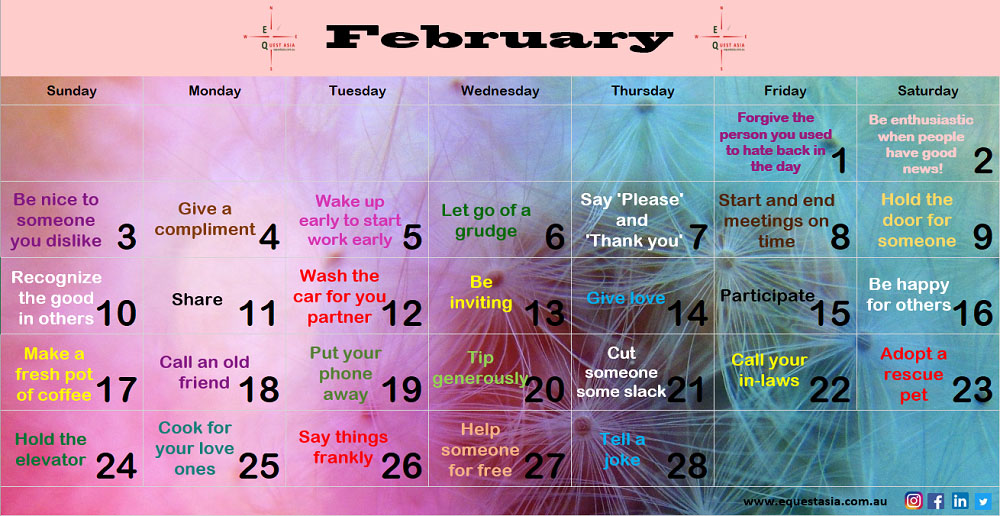
February is the second month of the year in the Gregorian calendar and its predecessor, the Julian Calendar, and is the only month that has less than 30 days.
Gratitude Calendar: Month of February Read More »

Positive Leadership is about putting the emphasis on what elevates individuals, teams, and organizations.
Positive Leadership: Its the best kind of leadership Read More »

A respected researcher, Sigal Barsade who’s been looking into and studying emotional contagion for many years says emotions spread among people like a virus that thrives in the air. From her findings and observations from other research studies on the subject, here are three ways through which your emotions are actually spread : The inflection of your voice – It’s one of the principal ways we transmit how we feel to other people and generally, they’re able to grasp the feelings they deduce from the tone of our voice. In other words, it’s not so much what you say, but how you say it. In an interesting study conducted by Roland Neumann and Franz Strack, they had participants listened to several actors reading an impartial spiel using happy, sad, and neutral inflections. The findings? The group who listened to the actor with a positive inflection reported feeling optimistic. Those who stayed with the actor with sad inflection didn’t like it at all. Our tiny facial muscles – Experts say that when we talk with other people, we are unaware that we’re mimicking the micro-movements of the other person’s facial muscles. This happens automatically in milliseconds, without us being conscious of it. Be it their lips, eyebrows or eyes, we’re actually attuned to the subtle movements of other peoples’ tiny facial muscles. For instance, when you see a guy who just spotted a tiger nearby, your brain cells, called mirror neurons decode the other person’s facial expression as an expression of his fear. This involuntary mimicking activates a mental and emotional state that jives with the other person so that you yourself also feel his fear and could have spelled the difference between life and death. Facebook posts- While the previous two surprising ways emotions are spread mostly have to do with subconscious movements and mimicry, verbal and non-verbal cues, a A study done by Facebook and published in Proceedings of the National Academy of Sciences in the United States says emotional contagion can also happen based only on words. In this study Facebook steered users news feeds towards mostly positive or mostly negative content. The users’ subsequent posts turned out to be either more positive or more negative depending on which group they were in. These observations indicate that emotions expressed by others on Facebook also influence our emotions, constituting evidence (though experimental) that this expansive emotional contagion could also occur and in fact, be happening in social media. So, what’s the point of all this? This whole exercise says we’re spreading our emotions without knowing it or simply being unaware of it. So, if you want to make sure you’re spreading what you’d like to transmit, then take care of yourself, emotionally.
Did You Know You Could Communicate Your Emotions In 3 Surprising Ways? Read More »

Creativity, innovation and a propensity to think out of the box have been proven to be the hard-working, tested characteristics of an organization that have become a successful player in the industry they move in and pursue their business.
What organizations need in order to be creative? Read More »

When the whole world gets a kick out of seeing people smile … when even medical experts say it takes less muscles to smile than to frown … it’s sort of weird to know that some cultures actually frown on smiling. You know what they say … truth is stranger than fiction. And it’s true. Some societies do not encourage casual smiles. In Russia, it is said there is an old proverb that translates into something like “Smiling or laughing for no reason is a sign of stupidity.” And, this cuts both ways. When these people come visiting to the U.S., they would most often think it odd to be smiled at by total strangers. The Big Question : Why? A recent report by Kuba Krys, a psychologist at the Academy of Sciences in Poland provides some answers. His paper says that in some countries, smiling is not perceived to be a sign of warmth or even respect. It is seen to be a sign that you’re a fool, a fool out to trick people. Krys focused on a cultural phenomenon known as “Uncertainty Avoidance”. Countries which generally rate low on this scale would have their social systems (i.e. social security, health care system, safety nets, etc.) unstable and shaky. Ergo, people would view their future as being unpredictable and erratic with very little control. So, when you come right down to it, smiling being a sign of certainty and confidence, people who would smile in these places with lowly-rated Uncertainty Avoidance would look odd. After all, why would you be smiling when your future looks like an invisible vulture waiting to eat you up? You might, in fact, under these circumstances be seen as a fool or stupid for smiling. They Don’t Smile In Corrupt Countries Either This expert psychologist went on to hypothesise that in corrupt countries, smiling would also be frowned upon. When everybody’s trying to fool you into a scam or pull one over one another, you’d never know if a person’s smiling because he’s got good intentions or because he’s trying to fool you. Testing The Theory To validate his theory, Krys had thousands of people in 44 countries judge a series of 8 smiling and non-smiling faces on a scale of honesty and intelligence. He then compared the answers against the country’s rankings on Uncertainty Avoidance for a study of 62 societies and ratings of corruption. What he found was that in countries like Switzerland, Germany, China and Malaysia, the smiling faces were rated as significantly more intelligent than those people who were non-smiling. On the other hand, in Japan, South Korea, India and Russia, the smiling faces were perceived as being significantly less intelligent. So What Does This Tell Us? It would seem that there is a strong correlation between how unpredictable a society is and the tendency to consider smiling as unintelligent. But let’s face it, at the end of the day … what have you got to lose by smiling. Smile and the whole world smiles with you!
Why Isn’t Everybody Smiling? Read More »


Simply complete the form below and we’ll get in touch with you, normally within 24 hours.
Enter your email address to download the Retooling Your Mindset eBook!
Enter your email address to download A Brief Guide to Happier Workplaces eBook!
Enter your email address to download Take a burnout test!
Enter your email address to download the EQuest Asia Brochure!
Enter your email address to download your document!
Thank you for sign up! Enjoy your download.
Thank you for sign up! Enjoy your download.
Thank you for sign up! Enjoy your download.
Thank you for sign up! Enjoy your download.
Thank you for sign up! Enjoy your download.
 Tiếng Việt