
Brain

Women Stay Mentally Sharp Longer Than Men

Before you guys start ganging up on me, take a look at what the experts have found out about the subject in several studies. Scientists have observed that women who are generally healthy have a “metabolic brain age” that is consistently younger than men of the same chronological age. What this finding indicates is that the changes and variations that occur when the brain uses energy over a person’s lifetime actually proceed more gradually in women than they do in men. While the research guys are clueless as to its medical consequences and implications, they say that this may help explain why, mentally, healthy females tend to stay sharp longer than males, Marcus Raichle, a neurobiologist at Washington University School of Medicine in St. Louis, says … brain metabolism changes with age. But his group of researchers also noticed that these changes boiled down to gender. In other words, when they started looking into how brain metabolism predicts a person’s age, the women came out looking about four years younger than they really are. How did they do it? – What the scientists did was to apply a brain-scanning approach called “Position Emission Tomography”.  It measured the flow of oxygen and glucose to the brains of one hundred twenty-one (121) women and eighty-four (84) men aged 20-82. This scanning technique showed how sugar was being converted into energy in the various parts of the respondents’ brains.  In infants and young kids, this process known as Aerobic Glycolysis is increased by nature to grow and develop the children’s brains.  This is scaled down however as they become adolescents and young men and women and it goes down steadily till it reaches a real low level when they reach their sixties. To see how this brain metabolism differed between the sexes, the researchers used a computer algorithm leading to the prediction of the respondents’ ages using their brain scans. So, what came out? The program estimated the men’s ages accurately. But it showed the women’s brains, on average, to be three-point eight (3.8) years younger than their real ages. Medically, the researches don’t know exactly what this means and intend to pursue further research on the subject. For now, they can only speculate that perhaps, low glucose metabolism in certain parts of the brain becomes more prone to memory loss and neurodegenerative diseases as a person gets older.

Women Stay Mentally Sharp Longer Than Men Read More »

Qualities of Mentally Strong People

Not a day goes by without challenges that test our mental toughness.  As we overcome these, new trials arise. Don’t be annoyed if you see happy people who seem to have no worries. Newsflash: They have problems too, but they’re not negatively affected by these. Why? They are mentally healthy. The good news is you can be like them.  Keep in mind that to be mentally strong, you’re going have to change your beliefs, behavior, perspective and outlook.   You can best decide what other areas in your life need a little tweaking.  For now, here are some qualities of mentally tough people that you may not be aware of. They Have a High Self-Esteem Mentally healthy people have an excellent yet factual opinion of themselves.  They’re confident, even though they’re not perfect.  They believe in their abilities which they continue to improve while seeking new ones to master.  When they encounter problems, they focus on finding solutions.  For them, life is not a series of problems, but a series of problem-solving! Don’t take your skills and strengths for granted.  List them down and you’ll realize you have more than what you thought you had. They Are Emotionally Healthy Mentally tough people never waste their energy wallowing in self-pity.  Life might have dealt them a bad hand. But, they make the most of what they have or the circumstances they’re in. They never feel sorry for themselves. Emotionally healthy people control their emotions, especially fear, sadness and anger.   In the face of adversity, they boldly rise to the challenge.  And when they pursue their goals, they do so with passion and determination. They Are Not Afraid of Failure Mentally tough people are always ready to take a leap of faith into the great unknown. They don’t listen to naysayers who may include their family or others close to them.  If they believe something is worth doing, they’ll forge ahead fully committed.   It doesn’t matter to them if they fail.  What matters to them is they tried. They Are Not Afraid of Rejection The fear of rejection is one significant deterrent for many people.  But, mentally healthy people like great salespersons don’t take it personally when they’re told “no thanks”, “another time perhaps” or even simply waved away.  They are self-assured, mentally and emotionally.  In the aftermath of rejection,   they simply move on with their confidence intact. They Stick To Their Dreams Mentally healthy people are unwavering when it comes to their aspirations in life.   They view challenges as mountains to surmount. They expect hardships and obstacles but do not avoid them.   Aware that there is no easy road to success, they stay the course.  At the end of the road, they know they will achieve their goals in life. They Never Stop Learning Socrates said that admitting one’s ignorance is the beginning of wisdom.  Benjamin Franklin and others have said something similar but the point is this – mentally tough people don’t pretend to know everything.  Despite having degrees, they continue to seek knowledge by reading books and other publications, searching the internet or enrolling in formal courses. Mentally tough people learn from their mistakes, failures and rejections.  They treat these as guides for their future actions.  Ask any successful person.  They’ll tell you that experience, good or bad, is always a great teacher. Wrapping Up If you want to be mentally healthy, you have to take seriously the qualities you just read.  With just the right effort and determination, you’ll achieve that mental toughness you desire.

Qualities of Mentally Strong People Read More »

"Why You, As A Manager Need To Develop Emotional Intelligence?"

“Why you, as a manager, need to develop Emotional Intelligence?”

One of the most essential traits of effective managers is having emotional intelligence. It is what gives them the ability to motivate people and have a good understanding of the value of connecting with others. It doesn’t matter what kind of business you, yourself might be involved in, but as a company manager, you need to get to know your people. It’s a tough job. It’s tough because there are so many complexities, even idiosyncrasies and personal traits for every individual. In the final analysis, no two persons are really exactly alike. Everyday Triggers. Simple everyday triggers can prompt you to be mad, glad, sad or happy. This is because, over time, we cognitively develop prompters that allow us to feel a certain way about things and events. 6 pm on a Friday can make you feel excited and anticipating. It’s your poker night with the boys! You cry watching some silly late, late soap opera about a forlorn love affair. These emotions and triggers are examples of what make us rare and unique personalities, but it’s also what makes your job as a top honcho pretty darn hard. You must possess enough emotional intelligence to acquire an understanding of the guys who must follow your lead. When you don’t have this, your people would tend to feel disengaged at work. In essence what this says is that if company leaders are not doing a good job at leading, it’s almost a sure thing, they lack the emotional intelligence to motivate their teams and push them to achieving top performance. Here’s What Can Happen When Managers Lack Empathy Or Emotional Intelligence. The worst thing about these managers without empathy is that they’re mostly unaware of it. It’s a sort of a behavioral pattern where they can’t see beyond their own biases and beliefs. As such, people who work with them become not only discouraged, they also get to feel like they’re living in hell! Pretty soon, they’d be dragging their feet going to work. Sure, there are many ways and styles of leadership, but one that doesn’t appreciate the values of working as a team will always bring down a company’s productivity. There is today a continuing low level of job satisfaction among companies This is true surprisingly even among those employees who receive fat paychecks. Reason? Their leaders lack emotional intelligence and are therefore unable to empathize with their people. So, How Do You Develop Your Emotional Intelligence? There is no magic pill for this. Slowly but surely, get to know the guys in your team. Try to get insights and understanding of what’s going on and why these guys respond to orders and decisions in a certain way. The more you get to know about them, the clearer you’ll see their true motivations and how you can help make them better. Naturally, it will depend finally whether or not a person would want to change their bad habits and become a good potential leader, so really, you’ll need to get a feel for your people and hear them out. It can only be good for your organization. Don’t dilly-dally. Start developing your emotional intelligence now!

“Why you, as a manager, need to develop Emotional Intelligence?” Read More »

“Brainwriting: The best alternative to brainstorming”

For countless years, brainstorming was the big buzzword among large, progressive corporations and business organizations around the world. It’s been so ingrained in our working processes and systems, everybody but everybody was into it. Call in some members of the staff, put them in a room with a whiteboard and pentel pens, center on a problem or an issue and creative solutions will flow like the giant waterfalls of Niagara, right? Wrong. As it turned out in recent years, the professed effectiveness of brainstorming doesn’t come anywhere close to its popularity, such that today, management gurus regard it as highly overrated, pure folly and a waste of time. What The Research Says    In a research study conducted by the 3M company, it found that people working in teams or groups as in brainstorming sessions come up with thirty to forty percent (30-40%) less ideas than those individually working and their ideas tended to be of poorer quality. Why is this? What happens? “Anchoring” : During a brainstorming session there is this thing that crops up known as “anchoring”. This is where earlier ideas are likely to influence the rest of the discussions. Norms and limitations get to be established as to what good solutions might be. This then inhibits the expression of new or different ideas and which consequently engenders the nemesis of creative thought: Groupthink. Pressure Of Conformity : Because brainstorming is biased towards early ideas, it favors less the creative ones because of a phenomenon known as “Pressure of conformity”. As the brainstorming session goes on, the team members, wanting to make a good impression will often come up with the most obvious solutions. Everybody in the team then ends up centering on those ideas, leaving the potentially better ones unexpressed and unexplored.  “Brainwriting” : Write First, Talk Second As suggested by leading professors, Leigh Thompson and Loran Nordgren from the Kellogg School of Management in the U.S., an effective alternative to brainstorming could be “Brainwriting”. The whole idea is anchored on the principle that the process that generates ideas should be separate from the discussions. In other words, write first, talk second. Not like brainstorming, brainwriting is effective in generating ideas when performed in complete solitude. Backing this up is a finding in a related research study that says brainwriting generates 20% more ideas and 42% more original ideas than those groups who did their brainstorming the traditional way. The Reason Brainwriting Works. It works because when people think without outside influence or stimuli, their thought processes are not encumbered by any kind of judgment. There’s no pressure to conform, no fear of sounding and looking inane or being ridiculed. It’s a simple process of having everyone quietly write down their ideas and anonymously submit these. The whole team then discusses all the ideas in a systematic manner. And so the next time your organization starts to plan out a brainstorming session, bring out the idea of “brainwriting”. If it’s new creative ideas and solutions you’d be looking for, it’ll make sense to try this new creative approach.

“Brainwriting: The best alternative to brainstorming” Read More »

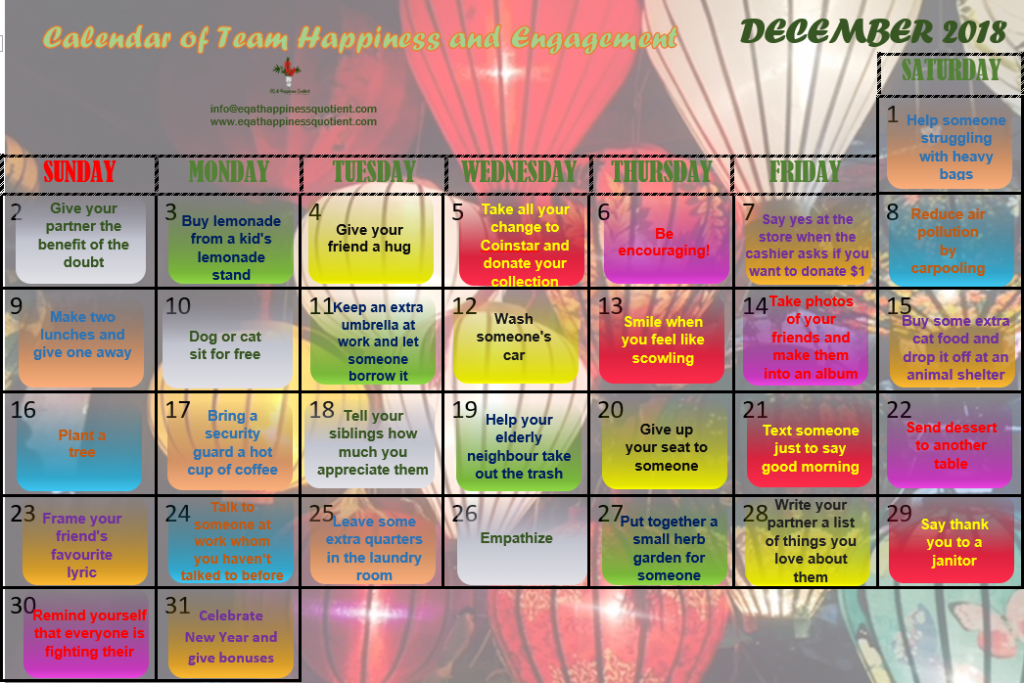
Month of December!

December is the twelfth and last month of the year in the modern day Gregorian calendar and its predecessor, the Julian calendar. The month kept its original name from the Latin word decem meaning “ten” which marked it as the tenth month of the year in the Roman calendar. It was named during a time when the calendar year began with March, which is why its name no longer corresponds with its placement in the Julian and Gregorian calendars. December was originally the last month of the old Roman calendar since the winter period was not assigned months. It originally consisted of 30 days, but its length was shortened to 29 days when the months of January and February were added around 700 BCE. During the Julian calendar reform, two days were added to December making it 31 days long. It is the seasonal equivalent of June in the opposite hemisphere. The month contains the winter solstice which is the shortest day of the year and marks the beginning of the winter season in the Northern Hemisphere. December starts on the same day of the week as September every year and ends on the same day of the week as April every year. Its birth flower is the holly or Euphorbia pulcherrima and birthstone is the blue turquoise or zircon.

Month of December! Read More »

viTiếng Việt
Scroll to Top

Contact Us

Simply complete the form below and we’ll get in touch with you, normally within 24 hours.

Enter your email address to download the Retooling Your Mindset eBook!

You have successfully subscribed to the newsletter

There was an error while trying to send your request. Please try again.

EQuest Asia will use the information you provide on this form to be in touch with you and to provide updates and marketing.

Enter your email address to download A Brief Guide to Happier Workplaces eBook!

You have successfully subscribed to the newsletter

There was an error while trying to send your request. Please try again.

EQuest Asia will use the information you provide on this form to be in touch with you and to provide updates and marketing.

Enter your email address to download Take a burnout test!

You have successfully subscribed to the newsletter

There was an error while trying to send your request. Please try again.

EQuest Asia will use the information you provide on this form to be in touch with you and to provide updates and marketing.

Enter your email address to download the EQuest Asia Brochure!

You have successfully subscribed to the newsletter

There was an error while trying to send your request. Please try again.

EQuest Asia will use the information you provide on this form to be in touch with you and to provide updates and marketing.

Enter your email address to download your document!

You have successfully subscribed to the newsletter

There was an error while trying to send your request. Please try again.

EQuest Asia will use the information you provide on this form to be in touch with you and to provide updates and marketing.

Thank you for sign up! Enjoy your download.

Thank you for sign up! Enjoy your download.

Thank you for sign up! Enjoy your download.

Thank you for sign up! Enjoy your download.

Thank you for sign up! Enjoy your download.