
Research Findings About Sticking To New Year’s Resolutions

“I’ll stop smoking from here on in.” “I resolve to pay my debts and I.O.U’s on a more regular basis.” “I’ll do some jogging every morning or do some brisk walking at night when I’m unable to get up from bed at sunrise.” With the onset of 2019, these are some of the most common New Year’s resolutions (not too many resolved to be less sexually active) you’ll hear from family and friends, colleagues and associates at work and school mates. Funny thing is … like promises, as some cynics might say, they’re meant to be broken. Let’s see what research has to say about these. Conducted by researchers at the University of Scranton, a 2014 survey found that seventy-seven percent (77%) of people stuck to their New Year’s resolutions during the first week. Six months after, this figure goes spiraling down to forty-six percent (46%). Given that fifty-five percent (55%) of resolutions are related to health and fitness and twenty percent (20%) has to do with paying off financial obligations, human behavior experts and psychologists felt this was quite disconcerting and dug deeper to get a better understanding as to why this happens. An analysis on the subject led by Ayelet Fishbach from the University of Chicago and Kaitlin Woolley of Cornell University found that, in a nutshell, people were less likely to stick to a resolution or a goal that did not offer an immediate payoff, or at least a reward that is obvious and can easily be seen. So what does one have to do to stick and follow through on a New Year’s resolution? Michelle Segar, director of Sport, Health and Activity Research and Policy Center at the University of Michigan says the trick is … to “feel like every little bit of self-improvement counts.” In other words, if you’re planning to join a ten kilometer (10K) marathon, you don’t train for just one day. Neither can you pay off a business or student loan with a single check? As the popular saying goes … there aren’t any elevators to reaching a goal. You gotta take the stairs. Some of the other hard-working tips that will help you stick to your guns re New Year’s resolutions are :  Stay away from temptations. If you resolve to stop smoking, stay away from people who smoke and pubs and bars that have that hard-to-ignore cigarette fragrance permeating the air. Plan a course of action. Resolving to pay off debts regularly? Calendarize it or have your payroll guy at the office deduct a portion of your paycheck each payday. And, most importantly, should you backslide into something you resolved to stop doing, it’s not the end of the world. Don’t give up on the goal or the resolution altogether. Stick to it like glue.

Research Findings About Sticking To New Year’s Resolutions Read More »
Did You Know You Could Communicate Your Emotions In 3 Surprising Ways?

A respected researcher, Sigal Barsade who’s been looking into and studying emotional contagion for many years says emotions spread among people like a virus that thrives in the air. From her findings and observations from other research studies on the subject, here are three ways through which your emotions are actually spread : The inflection of your voice – It’s one of the principal ways we transmit how we feel to other people and generally, they’re able to grasp the feelings they deduce from the tone of our voice. In other words, it’s not so much what you say, but how you say it. In an interesting study conducted by Roland Neumann and Franz Strack, they had participants listened to several actors reading an impartial spiel using happy, sad, and neutral inflections. The findings? The group who listened to the actor with a positive inflection reported feeling optimistic. Those who stayed with the actor with sad inflection didn’t like it at all. Our tiny facial muscles – Experts say that when we talk with other people, we are unaware that we’re mimicking the micro-movements of the other person’s facial muscles. This happens automatically in milliseconds, without us being conscious of it. Be it their lips, eyebrows or eyes, we’re actually attuned to the subtle movements of other peoples’ tiny facial muscles. For instance, when you see a guy who just spotted a tiger nearby, your brain cells, called mirror neurons decode the other person’s facial expression as an expression of his fear. This involuntary mimicking activates a mental and emotional state that jives with the other person so that you yourself also feel his fear and could have spelled the difference between life and death. Facebook posts- While the previous two surprising ways emotions are spread mostly have to do with subconscious movements and mimicry, verbal and non-verbal cues, a A study done by Facebook and published in Proceedings of the National Academy of Sciences in the United States says emotional contagion can also happen based only on words. In this study Facebook steered users news feeds towards mostly positive or mostly negative content. The users’ subsequent posts turned out to be either more positive or more negative depending on which group they were in. These observations indicate that emotions expressed by others on Facebook also influence our emotions, constituting evidence (though experimental) that this expansive emotional contagion could also occur and in fact, be happening in social media. So, what’s the point of all this? This whole exercise says we’re spreading our emotions without knowing it or simply being unaware of it. So, if you want to make sure you’re spreading what you’d like to transmit, then take care of yourself, emotionally.

Did You Know You Could Communicate Your Emotions In 3 Surprising Ways? Read More »

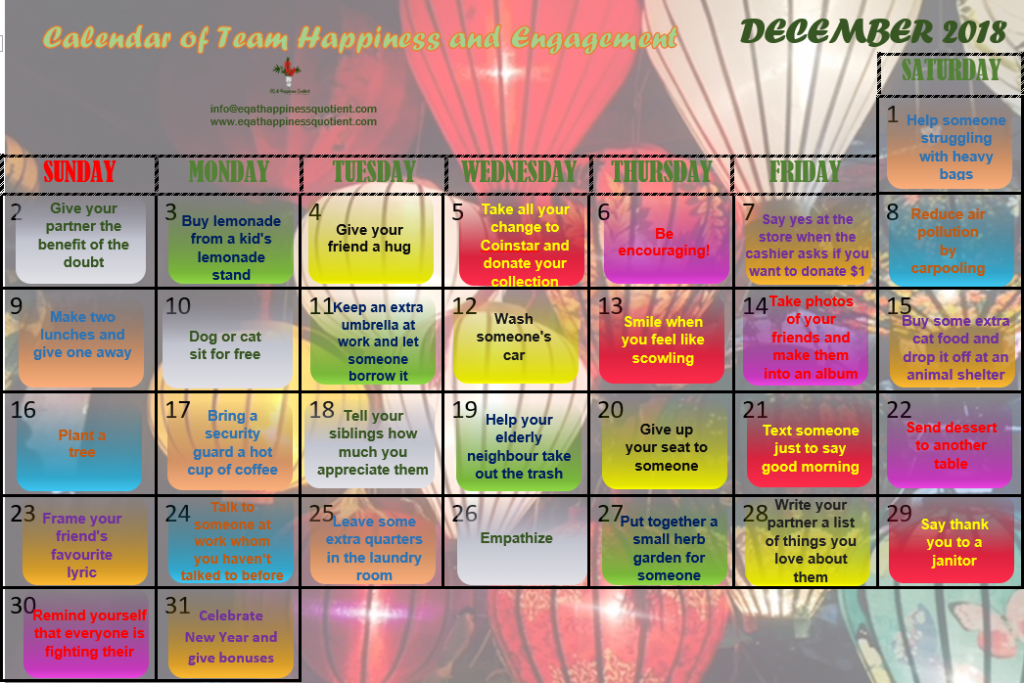
Month of December!

December is the twelfth and last month of the year in the modern day Gregorian calendar and its predecessor, the Julian calendar. The month kept its original name from the Latin word decem meaning “ten” which marked it as the tenth month of the year in the Roman calendar. It was named during a time when the calendar year began with March, which is why its name no longer corresponds with its placement in the Julian and Gregorian calendars. December was originally the last month of the old Roman calendar since the winter period was not assigned months. It originally consisted of 30 days, but its length was shortened to 29 days when the months of January and February were added around 700 BCE. During the Julian calendar reform, two days were added to December making it 31 days long. It is the seasonal equivalent of June in the opposite hemisphere. The month contains the winter solstice which is the shortest day of the year and marks the beginning of the winter season in the Northern Hemisphere. December starts on the same day of the week as September every year and ends on the same day of the week as April every year. Its birth flower is the holly or Euphorbia pulcherrima and birthstone is the blue turquoise or zircon.

Month of December! Read More »

viTiếng Việt
Messenger
Scroll to Top

Contact Us

Simply complete the form below and we’ll get in touch with you, normally within 24 hours.

Enter your email address to download the Retooling Your Mindset eBook!

You have successfully subscribed to the newsletter

There was an error while trying to send your request. Please try again.

EQuest Asia will use the information you provide on this form to be in touch with you and to provide updates and marketing.

Enter your email address to download A Brief Guide to Happier Workplaces eBook!

You have successfully subscribed to the newsletter

There was an error while trying to send your request. Please try again.

EQuest Asia will use the information you provide on this form to be in touch with you and to provide updates and marketing.

Enter your email address to download Take a burnout test!

You have successfully subscribed to the newsletter

There was an error while trying to send your request. Please try again.

EQuest Asia will use the information you provide on this form to be in touch with you and to provide updates and marketing.

Enter your email address to download the EQuest Asia Brochure!

You have successfully subscribed to the newsletter

There was an error while trying to send your request. Please try again.

EQuest Asia will use the information you provide on this form to be in touch with you and to provide updates and marketing.

Enter your email address to download your document!

You have successfully subscribed to the newsletter

There was an error while trying to send your request. Please try again.

EQuest Asia will use the information you provide on this form to be in touch with you and to provide updates and marketing.

Thank you for sign up! Enjoy your download.

Thank you for sign up! Enjoy your download.

Thank you for sign up! Enjoy your download.

Thank you for sign up! Enjoy your download.

Thank you for sign up! Enjoy your download.