Gratitude Calendar: Month of February
February is the second month of the year in the Gregorian calendar and its predecessor, the Julian Calendar, and is the only month that has less than 30 days.
Gratitude Calendar: Month of February Đọc thêm »
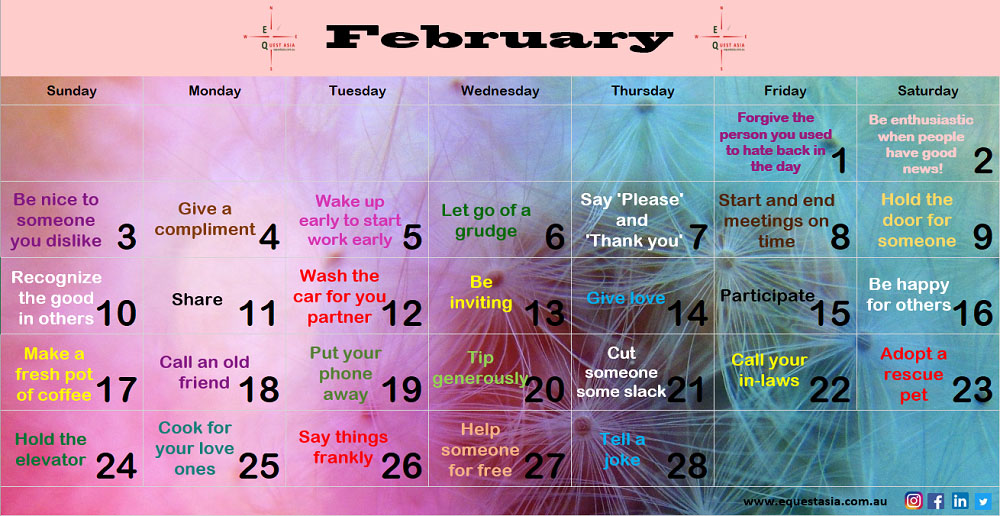
February is the second month of the year in the Gregorian calendar and its predecessor, the Julian Calendar, and is the only month that has less than 30 days.
Gratitude Calendar: Month of February Đọc thêm »

6 Behavioral Patterns That Say You’re A Genuine Person Most research studies have shown Emotional Intelligence (EQ) to be essential to job performance. In tests conducted among hundreds of thousands of people, it explains fifty eight percent (58%) of success in various types of jobs. Reports have it that ninety percent (90%) of top business leaders have high EQ and are known to make, on average, an estimated twenty nine thousand dollars ($29,000) more than people with low EQ. The Lowdown On Emotional Intelligence It’s a given truth. Emotional Intelligence is a force you can steer towards one direction and achieve great results. There’s just one catch to it. It doesn’t work if you’re not genuine. That’s because people don’t usually accept displays of Emotional Intelligence at face value. They’re skeptical. They don’t just want to see it. They’d like to know it’s real, sincere and honest and is not being used to manipulate things and people. This is a fact found in most surveys which say that leaders who are sincere are a lot more effective in motivating people. They inspire trust and respect with what they do rather than with what they say. In other words these genuine leaders walk their talk. Here are 6 habits that’ll help you determine if you’re one of the genuine people. Genuine people don’t go out of their way to please others. They are who they are. What you see is what you get. They know not everybody will like them neither will everybody dislike them but they’re OK with that. They’re not going to let that stand in the way of doing the right thing. They won’t hesitate to take unpopular positions or make unpopular decisions if that’s what situations demand. Genuine people don’t pre-judge. They keep an open mind which most people find interesting because they don’t make a judgment on people or form an opinion before they get to know them first hand. At the workplace, a person’s open-mindedness is important, as it makes him/her approachable allowing for access to new ideas and out-of-the-box thinking. Genuine people treat everybody with respect. Whether you’re a big client or a busboy in some fast food restaurant expect genuine people to treat you fair and square . They believe they’re no better than anybody else. Genuine people aren’t boastful or swell-headed. They are not insecure or in panic that if they don’t talk about the great things they’ve done, no one will notice. No. these genuine guys are confident about their accomplishments and know the merits of what they’ve done will stand on its own. Genuine people aren’t materialistic. For them, it’s not about fat checkbooks or fancy, glittering jewels or fine dining in posh restaurants. Not that they have anything against those things. They just don’t need them to feel happy. It’s from within that their joy comes. Family, friends and a sense of purpose … they’re what makes their lives full and rich. Genuine people share. They don’t hold back anything from you … not knowledge, not resources. They’re not afraid you’ll outshine or outperform them when they give you access to what they know and whom they know. They’d want you to do well. They believe your success is theirs as well. Putting it all together, you’d realise genuine people are sure enough about themselves and are firmly grounded in reality. They’re not figuring out somebody’s own agenda or even worrying about their own. They know who they are. If you still are in doubt as to who you are, go through these six behavioral patterns. Get them all right and I’d say … “Welcome to the Club!”
Are you a genuine person? let’s have a look at the behaviours…. Đọc thêm »

Well-being is about people feeling highly valued and supported in the job they do in their place of work. It’s also about their health, productivity and performance which can usually lead to good bottom line numbers for companies. Business organizations that are well-structured and well-managed generally play an essential role in the promotion of employees’ health and over-all well-being. The benefits they bring result in the reduction of absenteeism and malingering illnesses and facilitates ease and speed of recovery and return to work after either a serious injury or illness. At its simplest definition, well-being is about personal happiness, feeling good and doing one’s job in a safe and healthy environment. Why Is Well-Being Important To A Company? Experts in the corporate world say the cost of replacement of employees who resign can go as high as one hundred fifty percent (150%) of the departing employee’s salary, given the collateral costs of recruitment, hiring and training. On the other hand, business organizations which have a workforce that is highly engaged can reduce employee turnover by eighty seven percent (87%). You don’t have to be a rocket engineer to figure out its impact not only on a company’s net profits, but on the productivity, culture and over-all output of the business, as well. And so, if you haven’t as yet taken employees’ well-being seriously in your company, now’s a good time. Work out a wellness program with a system that’ll increase productivity and bring in good figures for your company profits. Even more importantly, develop a wellness package for your staff that will result in over-all happiness and health. Here are 5 easy-to-implement guides your company can adopt to create a well-designed wellness program to, not only raise your employees’ engagement level but as well, build a pervasive, positive culture in the workplace. Link your program to the company’s strategic direction. Get this running parallel with your company’s vision and values. This way everybody wins. Make sure you have a yardstick to measure your ROI. Launching a wellness program will naturally entail some investments. Put it all together with specific objectives and how success is to be measured. Check your rate of absenteeism, cost of employees’ wages and your company’s engagement scores. They’ll serve as an index against which you can compare performance after the program has been put in place. Get your top management to buy into the idea of a sound and well-grounded well-being program. It never hurts to have the support of everybody, especially the head honchos you might have to run too should problems crop up. Work out some quick wins. Provide initiatives that will help your staff to quickly jump in and level up. Don’t forget to have fun! The subject of wellness and health doesn’t have to be boring. Make sure your message is intriguing, trendy and to the point. It should inspire a change in behavior of your guys. Inject some lightheartedness into it or even some fun from time to time. With something like this in place in your company, don’t be surprised to see your people with smiles on their faces Monday to Friday!
The Importance Of Well-Being At The Workplace Đọc thêm »

It oftentimes happens that with the start of a calendar new year or a fiscal year among business companies, employers set up their employees to develop and achieve goals. Left to their own devices, these guys could pretty well be writing down traditional new year’s resolutions as in reducing weight or refraining from going to sleazy girlie bars or, they may simply go through the motion of listing down objectives as nonchalantly as doing the grocery list. Of course, it’s got to be a little more serious than that. Reason enough why employers should play a role in their staff’s goal setting. Here are several ways you (as a business owner or entrepreneur with employees) can help your guys set better goals: Reiterate the company’s mission. It’s funny. In a survey of three thousand US workers, only about four in ten know what their organization stands for and what makes their brand different from the rest. You have got to help employees better understand the over-all mission . Redefining this and sharing the company-wide goals will get your guys working towards goals that will run parallel to your company’s. Make the employee goal-setting a two-way affair. You can’t let this be the employee’s sole responsibility. You, as a manager have got to jump in and make it a collaborative process. Why? Because it’ll help to get those objectives more aligned with your company’s mission. Ensure you help make those goals as specific as possible as to include the who’s, what’s, when’s, where’s and why’s of it. And, use concrete numbers so you can quantify and measure the results in realistic terms. Set your employees up for success. Work out goals that are within reach or, you may want to break down long-term goals and set up timelines for what has to be done and when. This will make short-term, smaller goals more achievable which should provide the motivation to push on. Map out an achievement plan. Don’t stop at simply setting and defining goals with your employees. A goal achievement plan is essential as well. This is where you need to have control points as you get to know what needs to be accomplished for the quarter and how all concerned should actively work to address any issues that may have risen. This should also help to keep your guys on track. So you’ve been the conscientious manager who assisted the team members in the setting of goals. Now take a step back and review what you’ve collaboratively put down. Honestly, ask yourself the question … “Are these the goals that will inspire passion among my team members? Will these drive them to go the extra mile?” If you’re getting affirmative answers, give yourself a pat on the back and treat yourself to the biggest ice cream cone at Dairy Queen. If not, I don’t have to tell you… it’s back to the drawing boards till you’ve got something that’ll fly!
Help Your Employees Set And Define Better Goals Đọc thêm »

Gratitude in the workplace Everybody wants to feel appreciated. Gratitude is a crucial engagement factor in the workplace and often the biggest motivator, ahead of money. So how can you get this right as an employer and employee and what difference can it make? When ‘thanks’ in the workplace becomes solely the wage pack at the end of the month, employees can begin to feel undervalued and demotivated on a day-to-day basis. According to the John Templeton Foundation study of 2,000 respondents, people are less likely to feel or express gratitude at work than any other place. In turn, they did not rank their jobs as something they feel grateful for. Having said that, 93% of respondents agreed that a grateful employers makes a much more successful person to work for. Hearing praise makes somebody feel better. Positive psychology confirms that giving and receiving gratitude helps boost our self-worth, as well as our productivity. One study in Harvard Medical School by Wharton School (University of Pennsylvania) divided university fundraisers in two groups. Half were awarded gratitude and thanked for their efforts from the director, while the other half were not. Those who received gratitude produced more funds through fundraising than those who did not. A thank you costs nothing Gratitude does not involve the transaction of money, in the same way as a pay check does. Science Director Emiliana Simon-Thomas from the Greater Good Science Center conducted research that found that on days when someone gives or receives gratitude (or has experiences of gratitude), they feel happier. This is a cheap and effective way to improve workplace morale and productivity. Prolonged gratitude Dr Simon-Thomas also found that the people who prolonged their gratitude experiences were happier in their job, less stressed and reported better health. How to start giving and receiving more gratitude at work Gratitude works best from the ‘top down,’ in other words from hearing thanks from the boss. Those in a position of power have a greater impact in shifting workplace attitudes. A thank you needs to be clear, consistent and authentic Gratitude can be expressed in a number of ways, from throwing an office party or staff treat/gift, to complimenting the work somebody has done or built into performance reviews and appraisal meetings. Don’t take anybody for granted and remember those who, generally, do their job without looking for thanks. Sometimes these people tend to be at the bottom of the workplace pyramid and do jobs such as cleaning, filing or making a cup of tea. Make them feel valued. Quality, not quantity is key. If you say thank you, in a throwaway style, several times a day, it is less meaningful than a well thought-out expression of thanks that is justified and authentic. Cultivate a culture of gratitude in the workplace over time, so when an unsettled period arises or conflict, employees feel part of a team. Psychologist Robert Emmons says this process “builds up a psychological immune system.” Gratitude is a key word in the world of positive psychology and this article shows how developing it in the workplace will breed a culture of employees who feel valued and have higher self-esteem, therefore, work more efficiently and feel empowered by their jobs.
Gratitude in the workplace Đọc thêm »


Chỉ cần hoàn thành biểu mẫu bên dưới và chúng tôi sẽ liên hệ với bạn, thông thường trong vòng 24 giờ.
Nhập email của bạn để tải Tái Cấu Trúc Tư Duy eBook!
Nhập email của bạn để tải Cẩm nang Tạo dựng Môi trường Làm việc Hạnh phúc - eBook!
Nhập email của bạn để tải bài kiểm tra Đánh giá tình trạng quá tải!
Nhập email của bạn để tải EQuest Asia Brochure!
Nhập email của bạn để tải tài liệu!
Cảm ơn bạn đã đăng ký! Chúc bạn tải xuống thành công.
Cảm ơn bạn đã đăng ký! Chúc bạn tải xuống thành công.
Cảm ơn bạn đã đăng ký! Chúc bạn tải xuống thành công.
Cảm ơn bạn đã đăng ký! Chúc bạn tải xuống thành công.
Cảm ơn bạn đã đăng ký! Chúc bạn tải xuống thành công.
 English (Australia)